
Graduate students Lijun Zhao and Bianca Aridjis-Olivos showcased their research with posters at Texas A&M’s 2025 Annual Spring Symposium. Read on to explore their abstracts:
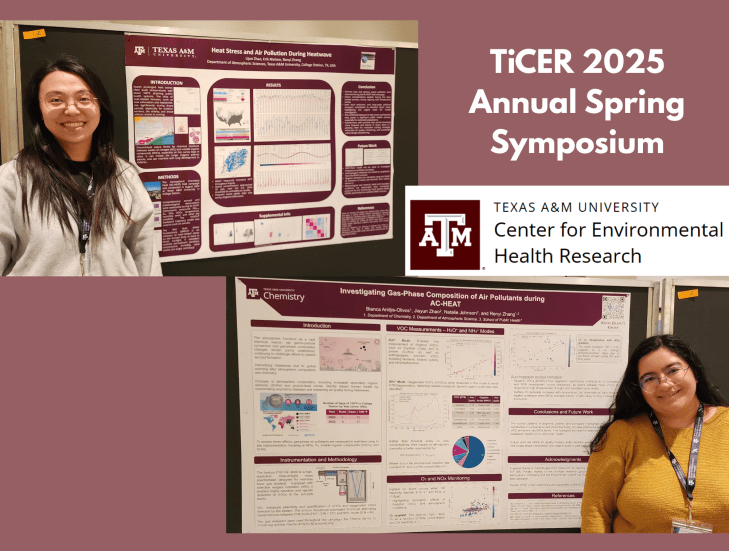
Heat Stress and Air Pollution during Heatwave
- Authors: Lijun Zhao*, Erik Nielsen, Renyi Zhang
- Department of Atmospheric Sciences, Texas A&M University, College Station, TX
Abstract
The Atmospheric Chemistry–Heatwave (AC-HEAT) field campaign was conducted in August 2024 in College Station, Texas, to investigate the intersection of extreme heat and air pollution during persistent heatwave conditions. While the heat index is commonly used to represent how hot it feels to the human body, this study employs the Wet Bulb Globe Temperature (WBGT), which provides a more comprehensive metric by incorporating temperature, humidity, wind speed, sun angle, and cloud cover. WBGT is particularly relevant for assessing heat stress in outdoor environments. During AC-HEAT, WBGT consistently exceeded 90°F on a daily basis, indicating hazardous conditions for individuals engaged in outdoor activities. Concurrently, elevated concentrations of ozone were observed, with levels frequently reaching or surpassing 70 parts per billion (ppb). The data reveal a steady upward trend in ozone throughout the month. The co-occurrence of extreme thermal stress and high ozone concentrations poses a significant threat to public health, particularly for vulnerable populations. This finding underscores the importance of integrated environmental monitoring and risk communication strategies that consider both thermal and chemical stressors during heatwaves.
Investigating Gas-Phase Composition of Air Pollutants during AC-HEAT
- Authors: Bianca Aridjis-Olivos*, Jiayun Zhao, Natalie Johnson, Renyi Zhang
- Departments of Chemistry, Atmospheric Sciences, and School of Public Health, Texas A&M University, College Station, TX
Abstract
Record-breaking heat waves in the southern United States during the summer of 2023 highlight the urgent need to understand how extreme heat alters atmospheric chemical processes, particularly those involving NOx, O3, VOCs, and secondary organic aerosols (SOAs). In response, a pilot field campaign program was developed and launched in August 2024 involving multiple research groups from the Center for Atmospheric Chemistry and the Environment (CACE) at Texas A&M. This poster will present the gas phase analysis of ambient particulate matter using the Ionicon proton transfer reaction time of flight mass spectrometer (PTR-ToF 4000) with selective reagent ion sources (SRI). Additionally, concurrent measurements of O3 and NOx provide insights into photochemical processes under extreme heat conditions. This ongoing project aims to improve air quality management strategies and inform public health responses by enhancing our understanding about the interactions among heatwaves, VOC emissions, and pollutant formation, ultimately contributing to better preparedness and mitigation efforts.
 Dr. Renyi Zhang's Group