
Authors: Bianca Aridjis-Olivos*, Jiayun Zhao, Natalie Johnson, and Renyi Zhang
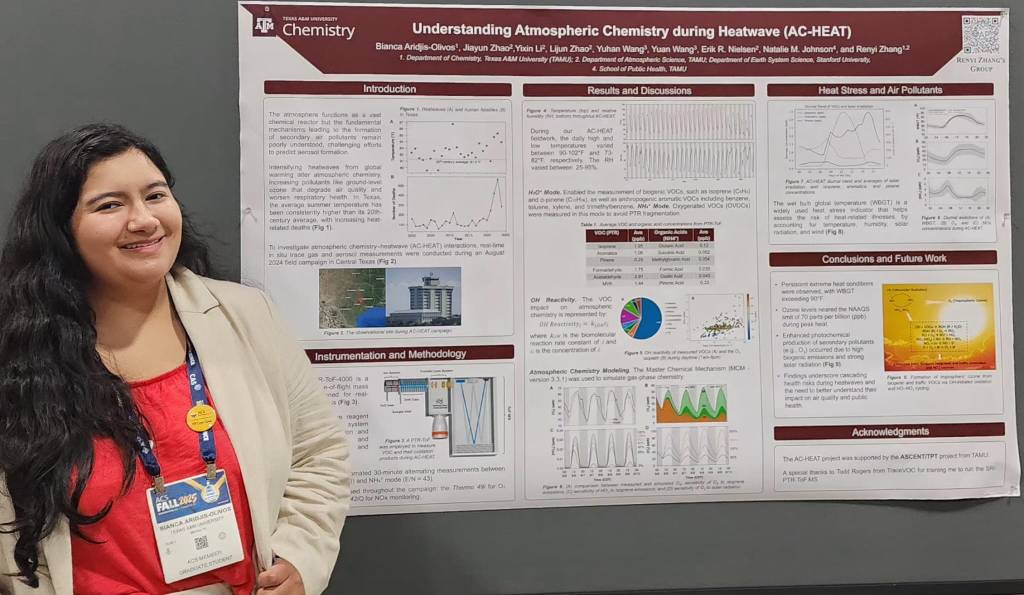
The abstract by Bianca Aridjis-Olivos on gas-phase pollutant dynamics during heatwave conditions was presented at the ACS Fall 2025 in the Environmental Contaminants session (ACS Division of Environmental Chemistry) and selected for Sci-Mix, a distinction recognizing top contributions across the American Chemical Society.
Climate change and air pollution are two interconnecting environmental crises that confront humankind in the 21st century and are closely tied to the variations in atmospheric compositions. Since pre-industrial times, rising greenhouse gases and aerosol levels have disrupted the Earth’s radiative balance, altered geochemical cycles, and impacted air quality and health. However, gas-to-particle conversion and changes in gas-phase composition remain poorly understood, as these interconnected atmospheric physicochemical processes continue to challenge efforts to predict future climate. The record-breaking 2023 heat waves in the southern U.S. highlight the urgent need to understand how extreme heat affects atmospheric chemistry, particularly NOx, O3, volatile organic compounds (VOCs), and secondary organic aerosols (SOAs).
Recognizing this critical gap, a pilot field campaign program was developed and conducted in College Station, Texas during August 2024 involving multiple research groups from the Center for Atmospheric Chemistry and the Environment (CACE) at Texas A&M. Real-time measurements using an Ionicon proton transfer reaction time-of-flight mass spectrometer (PTR-ToF-4000), equipped with selective reagent ion sources (SRI), are presented to ensure detailed gas-phase analysis of VOCs and their aerosol formation potential under heatwave conditions. Additionally, concurrent measurements of O3 and NOx provide insights into photochemical processes under extreme heat conditions. This study aims to improve air quality management strategies and inform public health responses by deepening our understanding of the interactions between heatwaves, VOC emissions, and pollutant formation, ultimately contributing to enhanced preparedness and mitigation efforts.
 Dr. Renyi Zhang's Group
One thought