
Authors: Maisha Kabir*, Yixin Li, and Renyi Zhang
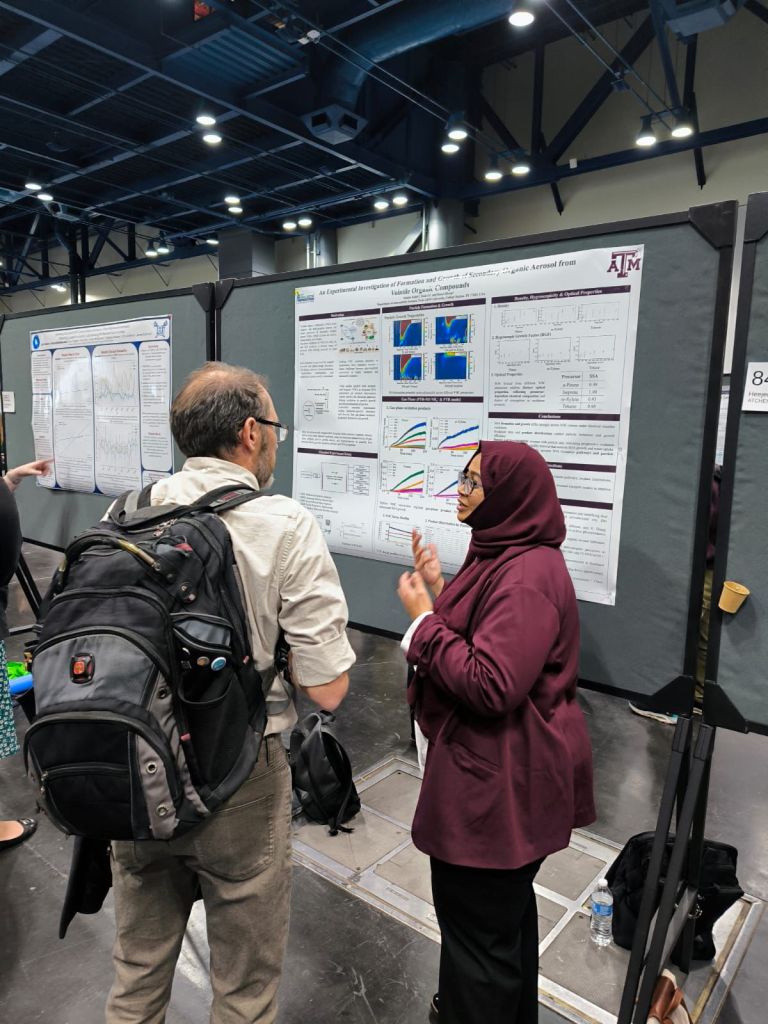
The poster abstract by Maisha Kabir was presented at the American Meterological Society (AMS) 2026 Annual Meeting in Houston, TX. Her work reveals how different VOCs like α-pinene and m-xylene drive the formation and growth of secondary organic aerosols, offering new insights into air quality and climate modeling.
Volatile Organic Compounds (VOCs) are emitted from biogenic and anthropogenic sources. Photochemical oxidation of VOCs leads to formation of tropospheric ozone and secondary organic aerosol (SOA), with profound implications for human and ecosystem health, weather, and climate. For example, SOA influences climate through aerosol–radiation–cloud interactions and affects human health via degraded air quality. Although VOCs are recognized as key precursors for SOA, the underlying mechanisms of the gas-phase photooxidation and gas-to- particle conversion for VOCs remain elusive.
Here, we examine formation and growth of SOA from the photooxidation of α-pinene, m-xylene, toluene, and isoprene in a dry, particle-free environmental chamber. Particle number–size distributions and effective densities were measured using a nano-differential mobility analyzer, ultrafine condensation particle counter, and aerosol particle mass analyzer, while gas-phase VOC precursors and their oxidation products were quantified in real-time by proton transfer reaction–mass spectrometry (PTR-MS) operated in both PTR and ammonium modes. Particle- phase compositions were determined via thermal desorption–ion drift–chemical ionization mass spectrometry. This presentation will focus on nucleation and subsequent particle growth of SOA from the distinct types of VOCs. Our findings provide new constraints on how different VOCs contribute to formation and growth of SOA, offering insight into the fundamental chemical mechanisms and informing improvements for SOA representation in predictive atmospheric models.
 Dr. Renyi Zhang's Group